Tuesday, July 6, 2010

The Wines of Bodegas Ribas, Mallorca


Mallorca's Bodegas Ribas is the third oldest winery in Spain, according to Ribas family member and current winemaker Araceli Severa. The estate now produces 130,000 bottles a year from their 40 hectare holding around Consell, near Binissalem, the island's main wine town.


We were fortunate enough to be given a tasting by the lovely Araceli when we visited the bodegas on a very hot day in June. For her part she was forced to suffer the misfortune of witnessing two large, doughy Irish boys drip sweat all over her air-conditioned tasting room. There are some things which science cannot explain, eg why my sternum sweated profusely throughout the tasting. Anyway...

Araceli is the chief winemaker at Ribas and has an impressive pedigree, having worked with Clos Magodor, Clos Erasmus and Mas Martinet in Priorat, Achaval Ferrer in Argentina and Harlan Estate in Napa. This is an incredible array of some of the world's very finest estates, albeit all perennial high scorers with a certain American gentleman.

Ribas were amongst the first producers to plant international varieties in Mallorca, blending them with native grapes to compensate for some of the short comings of their indigenous varietals.

Prensal Blanc or Moll is the primary native white varietal on the island. Araceli explained that Prensal is a fairly neutral grape and tends to lack structure and aroma. As such it definitely benefits from blending with more aromatic varietals. Chardonnay is the main partner used in such blends throughout the island, see for example Macia Batle's blanc de blanc and Ribas' own Ribas Blanc.

As is often the way with tastings at family run winerys, things started in fairly shambolic fashion. We were offered a tasting of the Ribas Blanc 2009 upon arrival whils one of the staff who then left to fetch Araceli. Although it wasn't oxidised the wine was dead in the glass, and flat-lining on the palate. I glanced at my companion who was making a similar 'this is going to be terrible'grimace.

Still no sign of Araceli, and we were poured a glass of Ribas Rose 2009, which was equally dead. A long, and dreadful afternoon loomed ahead of us.

All this changed with the arrival of Araceli. Taking a sniff of our glasses, she dumped everything in sight with profuse apologies. She and the wine team had just returned from a week's trip to Bordeaux and no-one had bothered to check the freshness of the sample bottles in their absence.

She opened a fresh bottle of Ribas Blanc, which was unfortunately badly corked, and dumped this too. A third bottle of Ribas Blanc was opened and was utterly different from the first two. The defective cork was pocketed to be shown to her brother, who is in charge of cork purchasing, and the tasting began.


It turned out that Araceli had spent time in the rural county Cavan in her teenage years. Her father had decided to spend a couple of months fishing in the lakes and a thirteen year old Aracelli was forced to accompany him on this adventure. I am not sure that she remembered this trip with a particular fondness! We apologised as best we could and went on with the tasting.

Ribas Blanc 2009, Bodegas Ribas. 13% alc, 7.60 euro.
' Peachy and lactic with faint whiff of emmental. Nice lifted aromatics and some minerality too. Not hugely complex.'

The unoaked Ribas Blanc is currently a blend of 85% Prensal around 10% Chardonnay and the remainder is unlabeled Viognier. Araceli explained that Ribas had been amongst the first to plant chardonnay in Mallorca, and were now the first to start grubbing it up. The family have been experimenting with Viognier, but are now also looking into Chenin which can be used to add both aromatics and acidity to the Prensal.

The 'Ribas' entry level range also has as tinto blend of Mantonegro, Syrah, Cabernet Sauvignon and Merlot ( previous vintage sold out, 2009 not yet released), and a rosado ( Mantonegro, Callet and Merlot) which we decided to forego tasting.

The upper range is called Sio.

The Sio Blanc 2007 is a blend of Prensal, Chardonnay, Viognier and unlabeled Chenin. The wine spends 6 months in new French oak. Unsurprisingly this was more complex than the Ribas Blanc. The aromatics were more interestinng, and complex and there was a salty lick of minerality on the palate. This was medium weighted and pretty good, although it failed to shine served with seafood paella at a dinner later on that week. The 2007, was being replaced by the 2008 the week we were tasting.

The Sio Tinto 2008 14.5%, 13 euro (?) is a blend of 55-60% native Mantonegro coupled with Syrah, Cabernet Sauvignon and Merlot. Mantonegro is one of the two main native varietals used in the production of red wines, the other being Callet.
Mantonegro is a clone of Grenache, and suffers from the same tendencies towards lack of structure and high alcohol. It is bloody hot on the planes in Mallorca, where the majority of wines are grown, and this definitely comes out in the alcohol levels in the wine.

Sio Tinto spends 12 months in French oak, 50% of which is new, and 50% of which is 2nd use. The Cabernet certainly came through on the nose, as did a fair whack of alcohol. This was ripe, with plenty of black fruit and some plums too. Big alcohol but very pleasant, with a big dollop of oak into the bargain. I have a bottle stashed for winter- or later this summer depending on the weather, and will add a note in due course.

Ribas de Cabrera 2006. This is the luxury cuvee from Ribas developed in conjunction with the Perez family from Clos Martinet. This is a blend Mantonegro, Syrah, Cabernet Sauvignon and Merlot. 14.5% alc. 15 months in new French oak and 45 euro, an incredible amount for a wine from the island. This smelled and tasted of far more than anything near 14.5% alc, even with the permitted .5% margin of error. I asked Araceli and she was honest enough to admit that this monster weighted in at a massive 15.3% alcohol! The nose was full of big gobs of alcohol with minerality, Bovril and new oak. Definitely not my sort of wine, and I really don't see how this is going to come together into something more elegant, especially given the short aging capacity of most Mallorquin wines. There is plenty of flavour here but the alcohol is overbearing. Not my style of wine at all. No thank you.

In conclusion, we couldn't have asked for a more pleasant, informative and accomodating host than Aracelli. The wines are definitely good, although the alcohol levels take some getting used to. For me the Ribas de Cabrera is just too big and overblown. I am looking forward to trying the Sio red again and seeing how it is. The wines are definitely worth looking out for if you are in Mallorca.

Thursday, June 24, 2010

The Wines of Paul Kubler


The Kubler family have tended vines at Soulzmatt, south of Colmar since 1620. Such lengthy tenure is not unusual in Alsace, where wine families such as Trimbach, Hugel, (Leon) Beyer and (Paul) Ginglinger can all trace their wine connections as far back as the 16th and 17th centuries.


South of Colmar is definitely Gewurztraminer country. The main Grand Cru in Soulzmatt is Zinnkoepfle. The steep clay-limestone and sandy clay soils of the 68.4 ha Zinnkoepfle rise to 420 m and face southeast/south. The hot, dry microclimate is particularly suited to Gewurztraminer, which is the main varietal planted here. Pinot Gris and riesling are also plantes, alongside a smaller amount of illegal Sylvaner, which cannot carry the name Zinnkoepfle.

Despite this long history Paul Kubler's wines has recently taken a huge leap forward in quality thanks to the return of young Philippe Kubler to family's 9 ha in 2003. Philippe's own pedigree is impressive. After completing his diploma in Oenology at Bordeaux university he spent time with Denis Debourdieu- probably the best known white wine consultant in Bordeaux. Debourdieu gave Philippe the opportunity to gain hands on experience at, inter alia, Yquem, Doisy Daene and Clos Floridene. From there he headed to Burgundy, where he apprenticed with Colin-Deleger at Chassagne Montrachet before finishing his training with a stage at Cloudy Bay. His first vintage was 2004, of which I still have one or two bottles.


Philippe works organically, observing certain bio dynamic practices. He is not certified, and intends to remain so as he feels that his clients should be able to trust his integrity as a winemaker. He doesn't wish to be constrained by the impositions of certification bodies, or to pay for certification. All vines are picked by hand. Vinification takes place in old foudres. Philippe allows plenty of time on lees and uses battonage.

The Range:

The K range: these are good, restrained varietal wines available Pinot Blanc; Gewurztraminer; and Pinot Gris. They are dry, balanced and elegant, and perfect for the table.

Lieu dit:
The Lieu dit, or named place is increasingly common in Alsace, where many producers now offer a terroir-based range below Grand Cru level. Rieslings from Lieu dit are likely to be drier than their grand cru counterparts, although this is only really a rule of thumb. Sweetness in riesling is murdering the reputation of Alsatian riesling as one of the world's great white food wines, and as an outsider it is virtually impossible to know whether a given riesling contains 2g per litre or 20g per litre of residual sugar. Whilst some producers, eg Zind Humbrecht and Jean Paul Schmitt, provide some information on the label as to the dryness or otherwise of the wine this is the exception rather than the rule.

There is no pan-regional requirement for labeling of this kind. Hilariously the generic/ tradition riesling from most producers is invariably bone dry. This would appear to indicate that producers are aware of the demand for dry riesling to pair with food, yet practically all persist in producing wines with sugar levels well in excess of 5g/ l of RS. Despite asking many producers why this is the case, I have yet to get a satisfactory answer. Most claim that global warming, and the exposure of the better sites means riper grapes and therefore higher sugar. This is clearly an unsatisfactory explanation. How does Trimbach manage to produce bone dry riesling year upon year?

A quick tip for RS level verification is to see if the riesling is featured in the Guide Hachette, which gives the Residual Sugar figure at the end of each Alsace entry. This is available online (2008, and 2009 eds) on the Hachette website.

Back to Monsieur Kubler:


Philippe's Riesling Breitenberg 2006: is drier than the month-old, vulture-picked corpse of a screechy lemon-juice mouse in the Sahara. Nose full of lemon, sherbert, honey, apple, stone fruit( apricot) and a little kerosene. Medium minus body. Elegant, high acidity. Good, but not overly powerful.(Jan 2010)

The acidity here is searing, in a hurt your tummy way. This is definitely good, but still needs time to see if the acidity will integrate further. However 2006 was a dreadful vintage in Alsace for rot and there is not a hint of mushroom to be found here, which is an achievement in itself.

Weingarten Gewurztraminer 2005:
Philippe is, understandably, less concerned about residual sugar in his Gewurztraminer. This is demi-sec with a lovely floral nose full of rosewater.
A nice mineral hint to it too. Fairly elegant for this most inelegant of varietals.

Grand Cru:


GC Zinnkoepfle Gewurztraminer 2004:
Light, greenish gold colour. Lovely nose, quite restrained with lychees and pain d'epice spices. Quite sweet, beautiful weight and restraint on the palate. Bitter/ spicey finish crying out for food. Lovely with clear smokey minerality, hinting at long development ahead.

GC Zinnkoepfle Pinot Gris 2004:
Not tasted since domaine visit. No note.


Sylvaner 'Z' 2006 (13%): ( from the Zinnkoepfle)
Rich and honeyed nose. Leesy with milky/ caramel note on palate. Spice. Flat lining a little in terms of flavour profile/ lack of acidity? After 1 hr: Honey, spice, quince, nuts. Mango skin, tropical stone fruit. Salty caramel/ mineral aspect. Ice tea with lemon, miso soup?( I know, I know). A strange, fascinating wine. Really unusual and interesting.

Sunday, May 9, 2010

Exams put blogging on hold

Just a quick note to say that I am up to my bubbies for the next couple of weeks with exams, so no blogs. Off to Mallorca for two weeks after that so hopefully will be able to put up a couple of related bits and pieces about the lovely wines of Binissalem.
In the meantime all prayers gratefully received!

Thursday, April 8, 2010

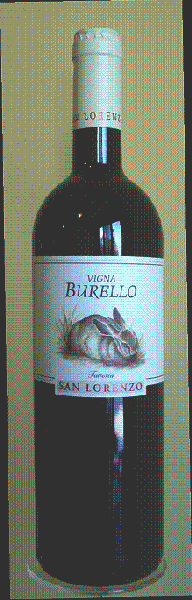
Vigna Burello, Fattoria San Lorenzo, Rosso Piceno 2005


Fattoria San Lorenzo's Irish importer, Enrico Fantasia, has just returned from the Marche and gave me a hot tip that this wine was far more complex than he had initially thought, and is drinking superbly at the moment. He said that after a few hours in the decanter the Sangiovese aromas take over from the fruity Montepulciano. Such was the depth, complexity and elegance that it could be mistaken for a good standard Brunello.


The front-label also features a large Durer-esque rabbit, making it the ideal choice for Easter Sunday lunch. Unfortunately my taxonomist brother was able to clearly identify the aforesaid bunny as a hare, and I was back to relying on the quality of the wine alone to sway the punters.

Vigna Burello is a blend of 60% Montepulciano and 40% Sangiovese from the Rosso Piceno region of the Marche, on Italy's Adriatic coast. Fattoria San Lorenzo are better known for their white Verdicchio di Castelli di Jesi cuvees than for their reds, but the Burello is simply fantastic. Fattoria San Lorenzo produce just 5000 bottles a year. Grapes from 30 year old vines, grown with a south-east exposition are fermented in open vats, then macerated for 25 days. The wine is then aged in 28 hl botte before bottling.

2005 was a good vintage in the Marche. God had wrung out the clouds over Chianti and Brunello so that there was little rainfall to spoil the fun in Rosso Piceno.

The result is medium bodied, round and polished. Complex with lots of leathery cherry, tea and a touch of liquorice/ aniseed. bright acidity and long finish. The alcohol (13.5%) is discernable, but in balance. Perfect with fatty meats and sheep's milk cheeses.

Vigna Burello, Fattoria San Lorenzo, Rosso Piceno 2005 23.70 from Sheridans Cheesemongers, and selected retailers nationwide.
A serious bargain for an Italian wine of this quality. Highly recommended.

Wednesday, April 7, 2010

The Sampler, Islington


A visit to the Sampler is a must for those looking to accumulate a lifetime of vinous memories in a single afternoon. Those looking to fritter away seventy pounds in the space of thirty minutes may also enjoy themselves here.

The setup at the Sampler is basically the same as at Enowines in Monkstown, but on a London scale. The shop is equipped with ten enomatic wine dispensers, each stocked thematically. The machine works by blanketing open wines with nitrogen, meaning that oxygen cannot get at it. Open wines can therefore be kept in the machine for a couple of weeks without fear of oxidation, meaning that there is no fear that the proprietor will end up throwing out half a bottle of Screaming Eagle because it oxidised before he could sell it all.

But back to the Sampler. At the very top end is the wine icons selection, stocked with wet dream wines which you thought you'd never get to taste, the sort of wines that are terrifying to even pick up let alone buy. This selection changes weekly and the current listing can be found at www.thesampler.co.uk. This week's selection features 1971 Tignanello, 2006 Tignanello, Chateau Latour 1971, Pichon Baron 1961, Pichon Baron 1989,El Nido 2006, Faiveley Clos des Cortons 1990 and Caymus Special Selection 1997.

Other machines are stocked according to variety, theme or region. So we have Chardonnay; Sauvignon Blanc/ Pinot Gris; Other White Varietals; Riesling and Sweet; Cabernet/ Merlot; Shiraz/ Grenache; Spanish and Other Red Varietals; Pinot Noir/ Gamay; Italian Varietals.

You purchase a card from the counter, stack it up with credit then trawl the shop sampling from the machines. Samples come in single, double, or triple shots. The single is fairly meagre, but gave both of us two sups each per wine- no gulps mind.

The Sampler is also a pretty damn good wine shop in its own right, featuring numerous bottle-aged wines, some at fairly decent prices.

We began with a Chateau de Fiezal, Pessac Leognan 1996 which was oxadative and interesting in equal measure, but I wouldn't be forking out for it; then onto Didier Dagueneau's Buisson Reynard, Pouilly Fume 2004 which was a seriously good, although 65 stg for a Sauvignon Blanc? We faffed our way over to the Chardonnay machine and tastes a 2002 Bourgogne Blanc from Pierre Morey (oxidised and past it) ; a Meursault Les Charmes 2001 (good) also from Morey; Au Bon Climat's Santa Ynez Chardonnay 2006 (tasty). Finally we finished whites with 2006 Schlumberger Pinot Gris Grand Cru Saering which was round, ripe and smokey whilst retaining some elegance. I think Schlumberger's Grand Crus are fairly underrated.

The Riesling and Sweet had no bottle aged examples rieslings, and nothing from Alsace so I gave it a miss.

Then it was on to the serious business of reds. It is increasingly difficult to taste wines with serious bottle age and the necrophile in me took over slightly.
We started with the Pinot Noir, I played the role of boring arsehole whilst my companion feigned interest. We started with a Delta Vineyard Hatter's Hill Pinot Noir 2007 which was pleasant with sweet fruit and a hint of smoke. Then a Chambolle Musigny 2007 from Hudelot-Baillet which was less yummy but more elegant and complex on the nose; then onto a Charmes Chambertin 1995 from Bouree which needed food, and was serious and underwhelming in equal measure.

From the Spanish machine we tried Rioja Alta 904 1989 was full of leathery strawberries and undergrowth but still all there and a 1970 Rioja Bordan Reserva which was decidely gluey and too old.

On to Italy, which I thought probably had the most interesting selection of all.
We started with a 1995 Chianti Fonterutoli from Castello di Fonterutoli. I had never had the chance to taste a bottle aged Chianti before- sad but true- and I really liked it. Celtic Whiskey Shop stock more recent vintages here. Then onto to G. Mascarello's Barolo Monprivato 1996, a stunningly good wine. Nose full of violet and rose with tarry undergrowth and enough fruit to support the traditional nebbiolo structure. FANTASTIC. I had tasted their 2001 Santo Stefano previously and it was damn good too. Not sure their wines are currently available in Ireland, except via Berry Bros website. Finished here with a 1961 Borgogno Barolo Reserva. 8 stg for a taste. This was good too, although perhaps a little porty, and couldn't live with the balance between fruity and secondary development in the Monprivato.

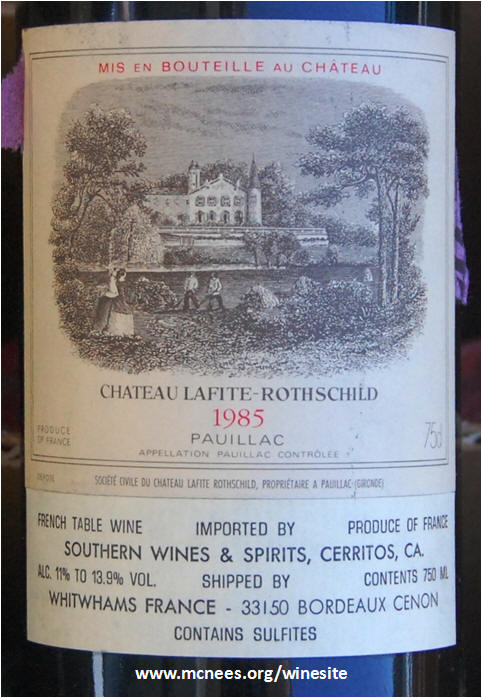
Finally onto the Icons machines. Annoyingly- it is remarkable to become this fussy this quickly- the Chave Hermitage Rouge 1998 was empty, but we held each other tight for a moment and continued tasting regardless. Scab that I am I balked somewhat at forking out 21.50 stg for a snifter of 1985 Lafite-Rothschild, but the wine illness won out and we split our couple of meagre mililitres. Brickish in colour, the nose was quintessentially left bank Bordeaux- I read later that Michael Broadbent described it as oyster shell- and who am I to disagree. This smelt a bit like Bordeaux when you are a kid and I wasn't overwhelmed by it. Good to tick the box and all that, but give me the funny money and I would buy three Monprivato every time- well maybe two Monprivato and a Chave Hermitage. We finished off with a 2001 Mouton Rothschild, which was my companion's favourite. This was mid-development and starting to take on dried fruit character. It was certainly good, and I probably preferred it to the Lafite.

We finished with a frantic dash around the shop. Having told the wives we were already in a taxi en route to meet them, I didn't feel I could spend more than 20 minutes looking around! I lined up a bottle of Domaine Arrextea Hegoxuri White 2008, and Arrextea Rouge 2006 and a half bottle of Hugel Tradition Pinot Gris 2000- a gamble but could have been yum. Unfortunately their machine wouldn't accept my laser card and I had to leave them behind.

Final thoughts. I had spoken to a friend who works with Enomatics and he says that although you can't taste the nitrogen which blankets the wine preventing the from oxidising, he feels the wines got a bit tired in the machine and tasted a little flat. I couldn't help feeling that this was the case in certain instances here. Then again maybe I am just very suggestible. The girl in the shop says they don't bother listing the non-icon wines on line because they change so rapidly. The icon selection is changed every week, so if every wine is there for a week or less there shouldn't really be an issue.

This is a great way to wine taste wines that you would never, ever come across otherwise. It is fairly expensive at the top end, but many of less stratospheric but nonetheless desirable wines cost less than a fiver and there are plenty of wines for a pound or two. Still I will remember that I don't particularly care for Chateau Lafitte 1985, and have inherited a richer man's wine memory for less than a gross meal out in Dublin.

Friday, March 26, 2010

RESTAURANT PATRICK GUILBAUD

Restaurant Patrick Guilbaud was far from full when we arrived for dinner at 8 o'clock on a miserable Thursday evening. Good scabs as always we began the evening at home, toasting my sister's thirtieth at home with a bottle of Mumm Cordon Rouge 1998 and Bollinger NV.

I have long been under the impression that Mumm NV is proper plop, but this was pretty damn good. Lovely autolytic biscuit notes and oodles of complexity, this was tasty, pinot noir led champagne. A bit of a cheese-y nose, and some undergrowth complexity. The Bollinger seemed fairly one dimensional in comparison, and had a metallic taint, a faulty bottle?

We arrived in Guilbaud's and were shown to our table. There were only three or four other occupied tables in the restaurant, and it was far from buzzing. This was the place where the tiger came to tea, so I suppose it wasn't so surprising that business appeared to be suffering. Undeterred we sat down and ordered a bottle of Chablis premier cru 2008, on the suggestion of the sommelier. To my shame I didn't catch the name of the producer, but it may have been Guillaume Vrignaud. This was structured, mineral, restrained in its use of oak and good, although I still prefer the iodine aspect of Jean Claude Bessin's wines.

Our bouches were amused by a perfect pairing of parmesan foam, red wine syrup and foie gras. This was truly fantastic, a real exploration of fermentation flavours and was probably the best thing I ate that night.
STARTERS
I chose truffle tortellini with warm baby leeks, hazelnut, potato mousse and a truffle vinagrette.
At 38 euro this consisted of three tortellini, sitting on the potato mousse, and topped by the leeks and hazelnuts. As the proud father of a relatively new baby I can attest that the leeks didn't actually taste of warm baby, but perhaps that is no bad thing. The dish was elegant and restrained, a sound combination of autumnal flavours. A slight criticism that the pasta was too thick at the edges, but overall this was good.

My sister went for the red king crab cannelloni, with pineapple, pickled ginger, baby herbs, and wasabi creme fraiche. This was all you could wish for in terms of light, fresh, clean flavour without resorting to lime juice or coriander- I know because I scabbed some! She was bowled over by the intensity of the micro greens and also, strangely that the wasabi tasted of wasabi but 'didn't hurt when you [ate] it'.A very good dish, and perfect lady starter food.

The Ma elected to try the stewed basque pepper terrine, with whipped goat's cheese, fennel confit, balsamic croquant and black olive tapenade. This was good, but not great. I didn't think the balsamic croquant had much to recommend it. It looked quite cool, but the flavour was not good. It tasted like burnt-y cake bits. Pretty punchy at 35 bucks, although a bit of a bargain relative to the omnivore's starters.

Pa Pa had the Castletown Bere Scallops, with cauliflower three ways, confit zest with grapefruit reduction and citrus seasoning. I purloined a piece of the scallop and thought it was perfectly cooked, although the Pa said he would have preferred it to have seen the pan for a minute more. He was wrong.

Main courses followed a bizarre interlude where empty plates were places in front of us, presumably to symbolise the lost fish course which we had decided to fore go. I shed a single golden tear. Goodbye my fishy friend. No cutlery was presented. I can't decide whether this made it all more of less bizarre.

MAINS:
Pa couldn't resist his favourite food, veal sweetbreads. These were served with endive and caramelized fennel, with an aribica glaze, and were pronounced excellent.

Despite her fear of bivalves Mama chose the West Cork Sole, Artichoke, Parsley and Shellfish nage. This featured a sizeable and perfectly cooked piece of sole, covered in a nage, which failed the scary bivalve test, and therefore passed mummy muster with flying colours.

My sister's turbot with carrot and star anise and seaweed butter, was a very good combination, featuring a generous portion of turbot.

I chose the Brittany pigeon, slowly roasted with parsnip and seasame and cocoa grue. This was quite a small portion compared to the fish to my right and left, but was good.

Wine wise I chose from a surprisingly well priced list, at least relative to continental urban two stars. Regular readers- are there any?- will know that I am a foul scab, but when in Rome...

I was tempted by the Trimbach Pinot Gris Reserve 2005 at 49 snots, which is a lovely wine but probably too big, even in the dry Trimbach style, to go with all the dishes chosen. I went instead for a superb A and P de Villaine, Cote Chalonnaise 'Les Clous' 2006. 100% chardonnay made on the personal estate of Romanee Conti owner, Aubert de Villaine. Both the reds and whites are fantastic and worth looking trying if you come across them. This was restrained and fine, with a certain yuminess, and a nose full of ripe orchard fruit and a hint of oatmeal. Perfectly balanced, this is a superb wine for the money. We also got two glasses of Simon Beze Bourgogne 2006 to go with my pigeon and the pa's veal, this was very good albeit at 12 a glass. Still when you can pay the same for a glass of absolutely crap pinot grigio in the Shelbourne perhaps this represents relatively good value?

We finished with a selection of fromages- more expensive than a selection of cheeses would have been. The condition of the cheese wasn't great. Not that they were underripe but rather that the rinds of the soft cheeses, particularly the washed rinds were dried out.m Twenty five quid verges on outrageous for 200g of cheese.

This was washed down with a glass of Trimbach Gewurztraminer VT 2002. The sommelier seemed surprised by this choice, conceding that it would be good with the blue cheeses but conveying an overall impression of deep scepticism. I have long thought that gewurz is probably the best variety to pair with cheese and it worked out well.

My sister's chocolate fondant with a warm criollo biscuit, milk chocolate and hazelnut centre and a stout ice cream was decidedly underwhelming. My sister is a chocolate fondant jedi and found this lacked real depth of flavour.

We finished with some good coffees and a plate of very average at best petit fours, including chocolate tuiles and cubes of orange jelly.

The bread throughout the evening was delicious.

Would I be running back with my own money? Probably not. It isn't that there was anything wrong with the food, some of it was very good and the amuse bouche was genuinely excellent. Amuse Bouche aside there was little in the way of genuinely exciting flavour combinations, and for this kind of money you can eat in some of the rural french three stars.. I suppose the 85 euro tasting menu is good value, but I think Guilbaud's is more about the service and being seen than a genuinely memorable gastronomic experience.

Monday, March 1, 2010

Yannick Amirault Le Grand Clos 2004, Bourgeuil


Yannick Amirault is widely regarded as one of the best red wine producers in the Loire.Yet his wines remain affordable and are a hot tip for anyone presented with a terrifying tome of a wine list in Relais et Chateaux restaurants. Guilbaud's used to list some 1995's but don't seem to have any left.


Yannick took over the 3.4 hectare domaine from his grandfather in 1977, and has built it up to 19 hectares today. Yannick's son Benoit joined the enterprise in 2003, and the pair are currently in the process of converting the domaine for organic certification.

Amirault makes a number of different cuvees of Bourgeuil, and St Nicholas de Bourgeuil- all from 100% Cabernet Franc. The fruity La Coudraye, La Mine, La Source and Le Rose are from sandy soils; the heavier, more serious Le Grand Clos is from clay-silex; and La Petite Cave, Les Quartiers and Les Malagnes are from and sand and clay mixture.

The wines are in short supply, so much so that Irish agents Sheridans/ Grapecircus were unable to secure any 2005s whatsoever despite having bought a large quantity of 2004s. Sheridans have just sold out of Le Grand Clos 2004, but still have some of the lighter, cheaper, and less interesting La Coudraye 2006 (16.95) in stock. This cuvee conforms more to light and fruity, chill it if you like, Loire red than the more serious Le Grand Clos. I think La Cave may still have a couple of bottles of Le Grand Clos 2004 on their list. Visitors to the Grand Epicerie in Paris can stock up on a wide range of Amirault's wines at very reasonable prices ( from 9 euro upwards).

2004 was not a decent but not fantastic vintage for Loire reds, nowhere near as ripe as 2005 or 2003 and probably on a par with 2002. Then again it wasn't a total wash-out and maybe you get more a sense of red Loire from an goodish vintage, than from a blockbuster year like 2003. Enough decent weather to get rid of dilute character and serious greeness, but not sufficient heat that you would never guess Loire. Think 2004 Bordeaux vs 2005. High levels of ripeness in 2006 prior to rain in September saved the harvest from washout. I would avoid red Loire 2007s, probably 2008s. 2009 is supposed to be savagely good, on a par with 2005 according to initial reports.

Anyway suffice to say that the Grand Clos 2004 (22.95) was just coming into its own. I tasted this a few years ago and it was good, but far too young. Now it had blackberry fruit with a hint of briar attached, restrained oak (2nd uses barriques from Chateau Margaux), smokey/ cigar box and some nice secondary characteristics starting to come through. Too bad this is the last bottle! Went very well with the huge veal cutlet from the butcher's in Donnybrook, which cost almost as much as the wine.